Create Your First Project
Start adding your projects to your portfolio. Click on "Manage Projects" to get started


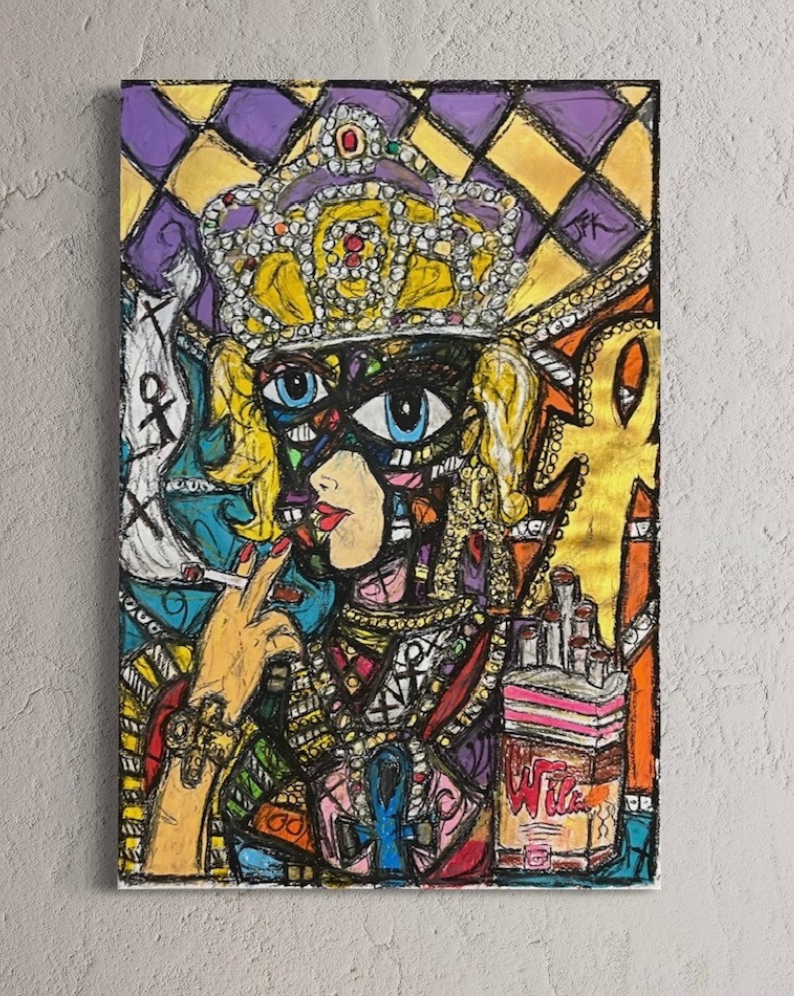
Wilton Cigarettes Series
The Wilton Cigarettes Series is study and Mr. Anjo’s retake on the Wilton Cigarette advertisements throughout 1950's and 1960's. The series painted by Mr. Anjo features Iconic Hollywood Actresses who were brand ambassadors and featured on posters/advertisements for the Wilton Cigarettes. These celebrities include Ava Gardner, Marilyn Munroe, Leslie Caron, Joan Crawford and Audrey Hepburn.
This particular subject is interesting due to irony and promotion of cigarettes and the perception of its benefits to the public/consumers in the 1940's, 1950's and 1960's under the Wilton company.
In the 1950s and 60s, tobacco companies bought and sponsored their own TV programs and paid A-list celebrities to appear in ad campaigns.
Smokeless tobacco companies have even used professional athletes to market their products.
Using celebrities to encourage others to smoke? That’s a scary story.
DOCTOR ENDORSEMENTS
In the 1940s, tobacco companies hired doctors and dentists to endorse their products to reduce public health concerns about smoking risks. Using slogans like “Just What the Doctor Ordered” and “More Doctors Smoke Camels,” tobacco companies misled people, showing that physicians were also smokers… and that cigarettes were fine for your health.
The most dramatic change occurred in the late 1950s and early 1960s. Until then, most health claims were made in direct verbal assertions, such as "more doctors recommend" . .. "not a cough in a carload" . .. "Scientific studies prove . . ." In the late 1950s, motivation researchers informed the industry that such ads drew attention to health problems, cautioning that a more oblique approach to the health issue would be beneficial. The new strategy replaced verbal statements with visual images in which healthiness was communicated through people and settings that were the very "pictures of health."
Until the 1970s, most tobacco advertising was legal in the United States and most European nations. In the 1940s and 50s, tobacco was a major radio sponsor; in the 1950s and 60s, they became predominantly involved in television.[29]: 100 In the United States, in the 1950s and 1960s, cigarette brands frequently sponsored television shows—notably To Tell the Truth and I've Got a Secret. Brand jingles were commonly used on radio and television. Major cigarette companies would advertise their brands in popular TV shows such as The Flintstones and The Beverly Hillbillies, which were watched by many children and teens. In 1964, after facing much pressure from the public, The Cigarette Advertising Code was created by the tobacco companies, which prohibited advertising directed to youth.[35]
Advertising continued to use celebrities and famous athletes. Popular comedian Bob Hope was used to advertise for cigarette companies
Prior to 1964, many of the cigarette companies advertised their brand by claiming that their product did not have serious health risks. A couple of examples would be "Play safe with Philip Morris" and "More doctors smoke Camels". Such claims were made both to increase the sales of their product and to combat the increasing public knowledge of smoking's negative health effects.. A 1953 industry document claims that the survey brand preference among doctors was done on doctors entering a conference, and asked (among a great many camouflage questions) what brand they had on them; marketers had previously placed packs of their Camels in doctors' hotel rooms before the doctors arrived,[53] which probably biassed the results.
Countless movie stars and celebrities have promoted smoking in ads and commercials, so it's not surprising that some suffered smoking-related cancers and other ailments, such as (clockwise from top left) Betty Grable (lung cancer), Spencer Tracy (heart disease), Barbara Stanwyck (congestive heart failure), Louis Armstrong (heart attack), Susan Hayward (lung and brain cancer), and John Wayne (lost a lung to cancer).
THE ART
The Medium:
Each works is painted on thick board paper (300 GSM) with acrylic paints and oil pastels with a fixer finish.
Size:
Each works sized at 594 x 841 mm or 23.4 x 33.1 inches
Year produced: 2024
Artist: Mr. Anjo
No. of pieces in the collection: 6
Each works includes: ANKH Symbol, CUBISM semi abstract faces, calligraphy and country flags.